Practical AI for Lean Teams: 5 Takeaways for SMBs
Written by:
GoTo Team
Published:
November 19, 2026
For a lean team, every technology investment comes with a question: who will make it work? AI can help employees get time back, but choosing, connecting, and supporting new tools take resources that many small and midsize businesses already struggle to spare.
IDC research presented in our recent webinar shows that more than 90% of SMBs expect to increase their technology budgets. Yet 39% of small businesses have no full-time IT staff, and secure implementation remains the number-one technology challenge for SMBs.
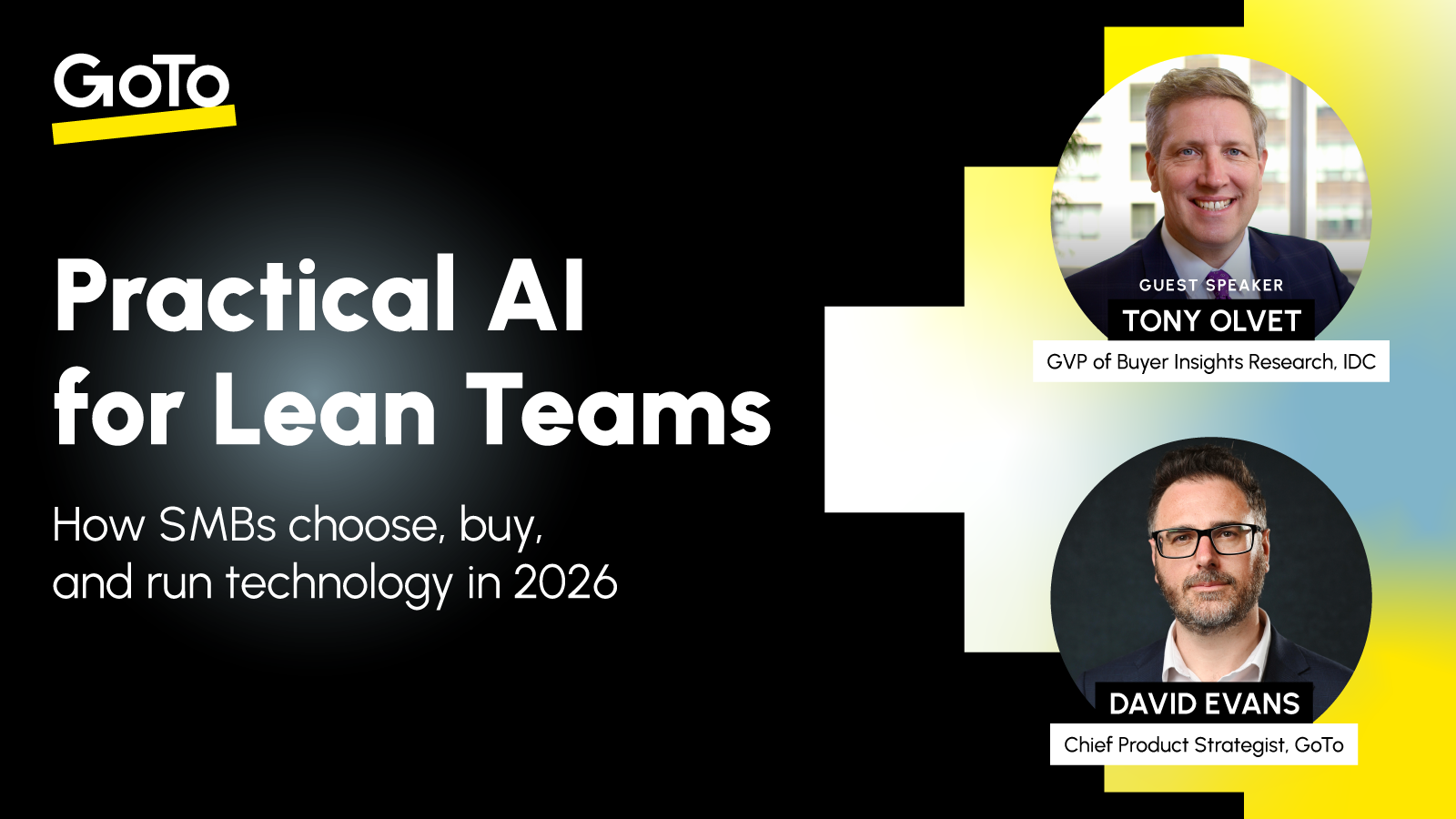
In our webinar Practical AI for Lean Teams: How SMBs Choose, Buy, and Run Technology in 2026, IDC guest speaker Tony Olvet (Group Vice President, Worldwide C-Suite and Buyer Insights Research) joined David Evans (Chief Product Strategist and Interim UCC General Manager, GoTo) to explore how businesses can turn AI investment into measurable results.
Here are five takeaways to help lean teams make their next technology decision.
5 takeaways from the webinar
Set a payback target before you buy
35% of SMBs now expect their digital and AI investments to pay back within three to six months, up from 21% two years ago.
Define success before making a purchase. That could mean a financial return, higher customer satisfaction, or fewer errors. Pick a task or workflow, measure it, and set a date to check whether it's working.
Start with the AI you already have
About half of SMBs use generative AI for content creation, and SMBs increasingly prefer AI built into applications they already use.
Content creation is just one starting point. Explore the AI capabilities in your existing tools to see where else they could help, including customer communications. If calls are going unanswered when your team is unavailable, AI could help cover that gap. Additionally, more and more tools are beginning to integrate in the AI your teams are already familiar with, such as Claude and ChatGPT. Pick a specific need from the tools in your existing tech stack and expand as you learn what works.
Ask vendors to demonstrate integration
Integration with existing IT ranks among the top three buying considerations across hardware, software, cloud, and third-party services. For software and cloud services, it ranks second.
Ask vendors to show how their technology connects with your systems and data before you buy. For example, a scheduling tool might look like a good fit until IT discovers it won't connect to your company's identity system. Involve IT early so your team can test those connections before committing.
Keep people accountable for high-stakes decisions
About one in three SMBs already use AI agents to manage or carry out tasks.
Whatever the use, human involvement should reflect the stakes. Our Pulse of Work in 2026 survey shows that 98% of IT leaders say their company is using AI, yet 87% say the outputs regularly need revisions. And it's costing their business. Email drafts and call summaries are easy for people to check quickly. Decisions involving pricing, customer commitments, or security need human judgment. A person remains accountable for the outcome to avoid costly mistakes.
Plan for support from the start
More than a third of SMBs prioritize access to the skills or services needed to deploy AI.
Trusted relationships and knowledge of the buyer's business also rank near the top of SMB buying criteria. Look for a provider that understands your needs, and even more so if you are in a specialized industry vertical with unique needs. Before committing, decide who will implement, support, and manage the technology, whether that's your team, a vendor, a reseller, or a managed service provider.
What this means for lean teams
An AI purchase is also a decision about fit, trust, and support. A tool's value depends on how well it fits the business and what support comes with it. Those questions belong in the conversation before you sign.
Watch the on-demand webinar for the full discussion, more IDC research, and guidance on getting value from AI with a lean team.