

AI has officially gone mainstream. But a new challenge is emerging: ensuring AI actually improves work and delivers business value. Adoption alone isn't enough anymore. The real differentiator is whether AI is improving outcomes for employees, customers, and the business.
According to our global study, The Pulse of Work in 2026, nearly every company is using AI in some capacity. Yet many organizations still struggle to measure ROI, reduce risk, equip employees with the right skills, and ensure AI improves productivity instead of creating more work.
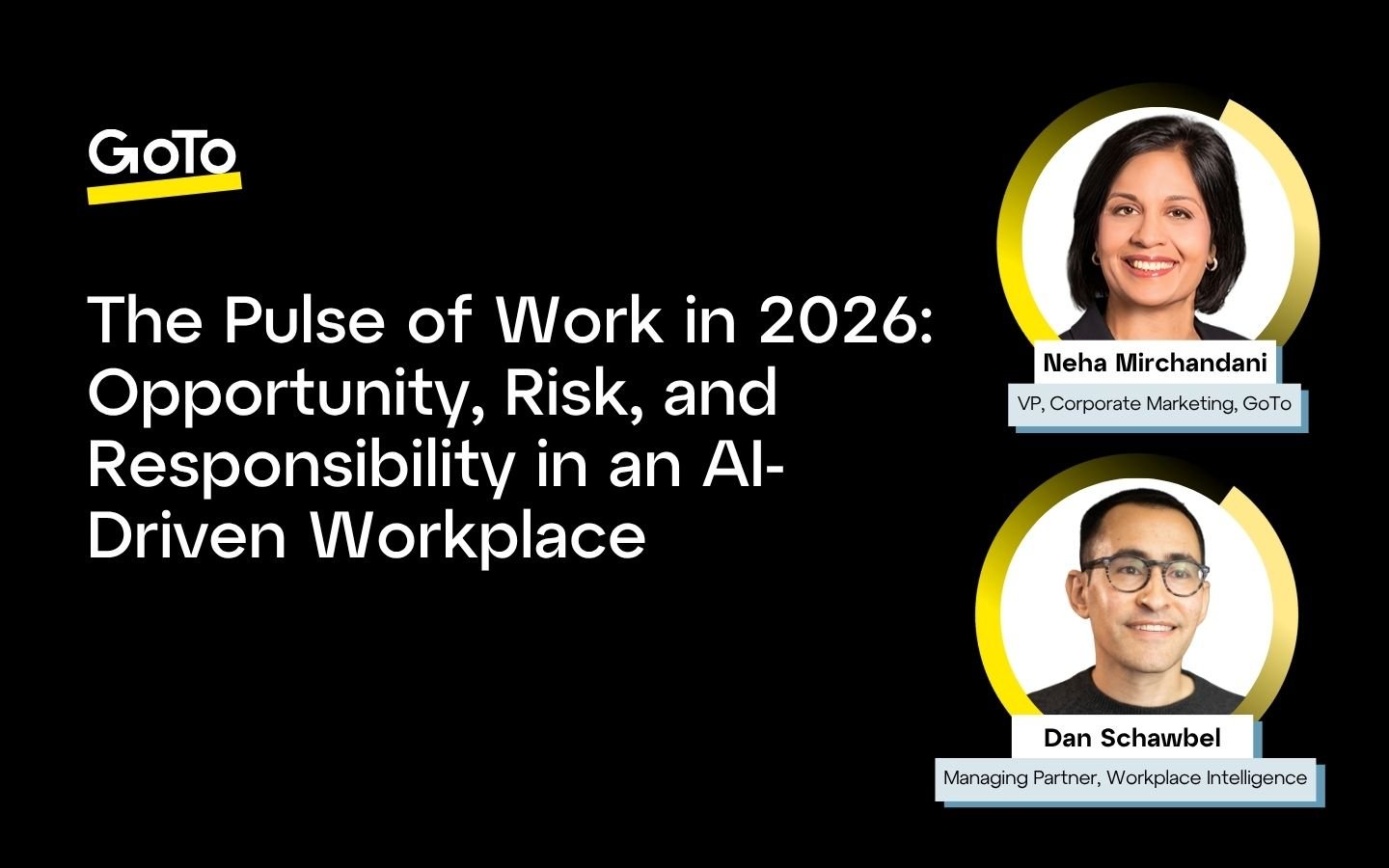
In our recent webinar, Neha Mirchandani (VP, Corporate Marketing, GoTo), Dan Schawbel (Managing Partner, Workplace Intelligence), Brandon Pedersen (Senior Principal Engineer, GoTo), and MP Kang (Deputy General Counsel, Privacy, AI, and Product, GoTo) unpacked the findings and explored what separates widespread AI use from meaningful AI impact.
Here are five standout findings from the discussion — and what they mean for organizations navigating the next phase of AI adoption.
5 revealing insights from the study
-
Adoption is easy. Measuring value is harder.
98% of IT leaders say their company is using AI, yet 43% admit they're not measuring AI ROI very well.
While AI usage is now the norm, companies have still not cracked the code on how to measure the returns on their AI adoption. Without clear ROI metrics, organizations risk scaling AI initiatives that create activity — not value.
-
The hidden cost of AI overreliance
50% of employees say they rely too much on AI, while 39% of employees (and 46% of Gen Z) find relying on AI is eroding their skills.
To ensure AI efficiency doesn't come at a human cost, businesses need to better equip employees to use AI intentionally and responsibly.
-
Faster outputs. More rework.
66% of employees say reviewing others' AI outputs creates more work for them, and 25% of IT leaders say AI mistakes have negatively affected customers or clients.
AI workslop is on the rise, which is why human review remains essential. If AI creates speed but increases rework, you're not actually getting the productivity benefit you think you're getting.
-
AI adoption is outpacing governance
56% of companies do not have an AI policy, and 78% of employees and 81% of IT leaders agree AI tools need better guardrails.
AI governance and guardrails are a necessity that allows organizations to scale AI without scaling mistakes. Both employees and IT leaders agree that better policies and guidance are needed to get the maximum value out of AI without increasing risk.
-
Human skills are becoming more valuable — not less
65% of employees think they are not being equipped with the right human skills as AI takes over more work.
As AI becomes more prevalent, human skills are becoming more valuable — not less. AI raises the floor on speed and execution — but humans still set the direction and standards, which requires judgment, creative thinking, emotional intelligence, and more.
The bottom line: what this means for IT leaders
The Pulse of Work in 2026 findings make one thing clear: AI adoption alone isn't a competitive advantage anymore. The organizations seeing meaningful impact are the ones investing in governance, measurement, workforce readiness, and human-centered leadership.
Watch the on-demand webinar to hear the full discussion, explore even more data behind the trends, and learn what separates widespread AI adoption from meaningful AI impact.